
By Chantelle Gladwin-Wood (Partner),
and Wandile Sangweni (Associate)
24 February 2026
By Chantelle Gladwin-Wood (Partner),
and Wandile Sangweni (Associate)
24 February 2026
INTRODUCTION
The City of Cape Town (“CCT”) has released its 2025 General Valuation Roll (“2025 GVR”) to the public for public inspection to submit objections from 20 February 2026 to 30 April 2026.
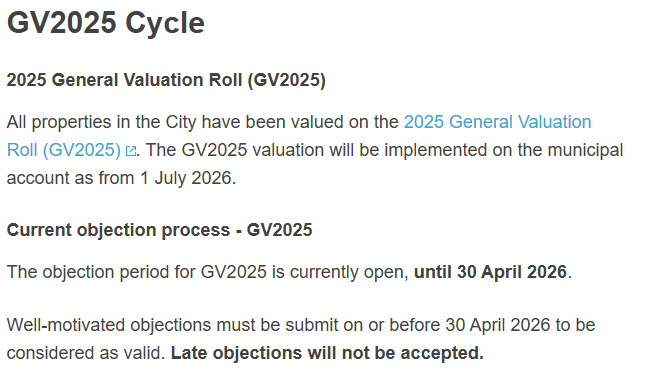
It is the responsibility of every property owner to check the municipal property valuation and categorisation ascribed to their respective properties and if the valuation is not in line with market value, or the categorisation is inappropriate, to submit an objection before the closure of the objection period.
Failure to do this will result in the value and categorisation ascribed to your property pertaining for the duration of 2025 GVR (which is 4 or possibly 5 years).
This means that for 4 to 5 years (from 1 July 2026 to 30 June 2030 or 2031) you might pay rates based on the incorrect property valuation and/or categorisation, unless you object outside of the prescribed time periods in terms of section 78 of the relevant Act (more on this below).
Property valuation rolls are quite complicated. Below is a brief explanation of how valuations and valuation rolls work:
WHAT ARE MY PROPERTY VALUATION AND CATEGORISATION?
Every property is supposed to have a municipal valuation ascribed to it by the municipal valuer.
You should see a value, represented in Rands, on your municipal invoice. This is the property valuation that the CCT has ascribed to your property for the purposes of levying property rate.
Similarly, every property is meant to have a rating categorisation ascribed to it by the municipal valuer. This should also appear on your invoice. The category is chosen by the municipal valuer from a list of categories that are set out in the CCT’s Rates Policy, and for each category there is a corresponding tariff (a rate in the rand price).
For example, business properties pay on average three times more than residential properties, because their tariffs are higher. The CCT’s Rates Policy can be accessed from the municipality’s website, alternatively, you can email public@hbgschindlers.com for a copy of the policy.
WHY DO THE VALUATION AND CATEGORISATION MATTER?
The amount that the CCT charges you for property rates each month, is based on your municipal valuation multiplied by the tariff (rate in the rand price) that applies to the categorisation that you have been placed into. If the valuation is too high, you will pay too much for rates. If the categorisation is wrong, you will pay the incorrect amount for rates.
For example, if your property is residential in nature but you are categorised as business, you will pay three times the amount that a residential property with the same municipal valuation that is categorised as ‘residential’ will pay.
The municipal valuation should be “market value”. Market value is explained below. For the 2025 GVR, the date at which your property should be valued, is 1 July 2025.
WHAT IS A VALUATION ROLL AND WHERE DO I FIND IT?
This is a database in which the CCT stores the municipal valuations of all properties recorded on that particular roll. Every property in Cape Town should (hypothetically) be on a general roll, but because properties are continuously coming into existence and ceasing to exist and changing form, new rolls are created (these are referred to as supplementary rolls) to include any properties that have not been previously recorded on another, prior, general roll. Supplementary rolls are released at least once every year during a GV.
Each general roll is re-published once every few years (4 to 5 years), and the property values updated at the same time. Depending on a number of factors, your property value may have stayed the same, or increased, or decreased, from the value contained on the last roll. The information on the valuation roll is used to calculate your rates and taxes each month.
Most valuation rolls are posted on the CCT’s website (as is the 2025 GV, which is available at https://web1.capetown.gov.za/web1/gv2025/SearchProperty ). If you cannot access the 2025 GV online for any reason, you can email valuations@capetown.gov.za or 0860 103 089 call them on for more information.
THE PROPOSED 2025 GV VALUATION AND CATEGORISATION OF YOUR PROPERTY
The CCT should give you notice if your property is appearing on a roll that has been published (including the 2025 GV). This notice should tell you what your current municipal valuation is, what your revised municipal valuation is, the name of the roll that your property is now appearing on, the existing and proposed categorizations, and where you can inspect the contents of such roll. These rolls contain only municipal valuations, categorisations and the other pieces of information listed above; they do not contain reasons for the valuations and categorisations.
If you have received notice that your property is on 2025 GVR, you should determine immediately whether you are satisfied with the municipal valuation and categorisation accorded to your property. If you are not happy, you should object. See the section below on objecting for more information.
*Note that the CCT’s failure to send you a notice telling you that your property is appearing on a roll, does not exempt you as the property owner of your obligation in law to check the roll and see whether you are happy with your property details as they appear thereon.
WHAT IS MARKET VALUE AND HOW CAN I DETERMINE WHAT IT IS?
‘Market value’ is generally explained as the price that a willing buyer would pay a willing seller on the open market for a property. However, there are a number of different methods that can be used to calculate market value. The most commonly used methods include the comparative sales method, the income yield method, and the depreciated cost method. The nature of these calculations are complex, and are usually done by professional valuers at a cost.
However, you can ask your local estate agent for an estimation as to the market value of your property, based on comparative sales and the agent’s experience of what the property would sell for in the area concerned. Agents don’t charge for providing these estimations.
You can also extract “automated valuation reports” from a number of different software packages designed to estimate market value, such as Windeed.
However, in some instances there will not be enough information available on the system to arrive at an estimated valuation, and because these reports are automated and there is no human interaction involved whatsoever, any subjective features of a property that would enhance or negatively affect its value are not taken into account. This can render the accuracy of these kinds of valuations less effective than valuers’ or agents’ valuations.
The general principle is that the higher the market value of the property, the more likely you will be to need to involve a professional valuer (at a cost) to assist you. The costs of incorrectly estimating your own property value can be significant, because of the time that it takes to resolve disputes regarding the valuation and the charges and interest that are billed while that dispute is pending, as well as the potential costs involved if it becomes necessary to involve attorneys.
Valuers can also advise you of the most appropriate rating categorisation for your property, but in a complex dispute you may need to approach an attorney that specialises in this type of law, within the jurisdiction of the CCT, for assistance.
WHAT DO I DO IF MY PROPERTY VALUATION IS NOT IN LINE WITH THE MARKET VALUE OR IF MY CATEGORISATION IS INCORRECT?
If you are of the opinion that your municipal property value is higher than market value or your rating categorisation is inappropriate, you can lodge an objection with the CCT against the information contained on the 2025 GVR, giving reasons for same. The CCT will then assess your objection and notify you of the outcome of same. If the CCT finds that your objection is valid, it will revalue and/or re-categorise your property in line with your objection. If it finds that your objection is not valid, it will advise you of same and your property valuation/categorisation will remain unchanged.
If you are able to access the 2025 GVR online, and your property appears on it when searching on the CCT’s website, you will be able to lodge an objection electronically through the website. If this option is not available to you, you can obtain copies of the objection forms from the CCT’s Valuations Department and submit a hard copy of your objection to the Valuations Department.
WHAT HAPPENS IF MY OBJECTION IS REJECTED?
You may appeal to the Valuations Appeal Board within a certain, prescribed time period, which is usually not less than 30 days from date of receipt of notification of the outcome of the objection.
The Valuations Appeal Board is only convened once every few months, but at the next meeting your appeal will be considered and either accepted or rejected by the Board. You will be given written notification of the outcome of the appeal.
WHAT HAPPENS IF THE APPEALS BOARD REJECTS MY APPEAL?
If the Appeals Board rejects your appeal and you are of the opinion that your appeal should have succeeded, you will need to approach an attorney for assistance to take the matter further legally. One possible option is to approach a court to review the decision of the Appeals Board.
CAN I OBJECT OR APPEAL OUTSIDE OF THE PRESCRIBED TIME PERIODS?
If there has been an error in the calculating of your valuation or your category is wrong, you can still approach the CCT’s Valuations Department to rectify this error outside of the prescribed time periods for objections in terms of section 78 of the relevant Act. However, this is a lengthy process, and slightly different rules apply. More information on this process can be obtained by emailing public@hbgschindlers.com.
MORE INFORMATION / FURTHER LEGAL ASSISTANCE CONTACTING CCT:
CONTACTING HBGSCHINDLERS: