

By Chantelle Gladwin-Wood (Partner),
Maike Gohl (Partner), Nombuyiselo Mvelase (Associate),
and Karabo Kupa (Candidate Attorney)
15 January 2025
Municipalities’ Penalty Charges in Relation to Unauthorised Use of Property
INTRODUCTION
Property owners who fail to comply with zoning laws, building regulations, or municipal by-laws may be subjected to steep municipal penalty charges, in the form of increased property rates charges, often without prior notice or procedural safeguards. These charges are not merely administrative formalities, they can significantly affect monthly municipal accounts and contribute to long-term property costs. As such, it is important for property owners to understand the legal framework underpinning these penalties, how they are imposed, and the limits of municipal authority in this regard.
For the purposes of this article, we will be focusing on the City of Johannesburg Metropolitan Municipality’s tariffs and laws; however, please do note that the majority of the principles discussed herein be applicable to any municipality in South Africa, so long as that municipality’s rates policy sets out an “unauthorised use tariff” or something similarly named, where that tariff is a punitive tariff.
WHAT IS A PENALTY TARIFF?
A penalty tariff is higher municipal rates charge levied against a property that is being used unlawfully or without the necessary authorisation. To illustrate this in practical terms, consider that at present, in the COJ’s 2025/2026 rates policy, the unauthorised use tariff attracts a charge of 12 times the residential tariff.
In City of Johannesburg Metropolitan Municipality v Zibi and Another1 the court described the penalty tariff as a financial sanction aimed at deterring unauthorised use of a property. In that case, the municipality had imposed a rate that was four times higher than the standard residential rate, due to the illegal use of a residential property as a commune.
In the Zibi case, the City’s application of the unauthorised tariff had been challenged, on the basis that in order to apply this tariff, the City would have had to have changed the category of the property on a valuation roll, given the consumer an opportunity to object thereto and only thereafter could it apply the unauthorised use tariff. In the High Court, the Zibi’s claim in this regard was upheld, however, in the Supreme Court of Appeal, the Court upheld the City’s appeal and found that to require this process was an unnecessary administrative burden.
The penalty tariff is typically calculated based on the market value of the property, but it is distinct from ordinary rates and taxes. Its purpose is punitive in nature. Essentially, such a tariff can only be imposed if a municipality has a valid property rates policy in place that provides for the levying of charges relating to “unauthorised” or “illegal” use.
Even in cases where the rates policy imposing the charge is unassailable, the legitimacy of this type of charge remains controversial. A dissenting judgment in the Zibi case questioned whether a penalty tariff qualifies as a “rate” at all under the Local Government: Municipal Property Rates Act or whether it is, rather, in substance, a sanction for unlawful conduct that requires a judicial process to be imposed. HBGSchindlers previously discussed its views with regard to this judgment in a prior article, the link to which is here: COJ and Zibi : The City’s New Approach to “Penalty Rates Charges”.
WHAT IS “UNAUTHORISED USE”?
The scope of penalty tariffs is (generally speaking) quite broad. They are generally made to apply to properties that are used in a manner not permitted under their zoning or applicable land use schemes, including uses contrary to municipal by-laws or national legislation. This includes properties that are abandoned or derelict, those used in breach of the National Building Regulations and Building Standards Act 103 of 1977, and properties involved in unauthorised advertising under municipal by-laws.
In terms of the current 2025/2026 Rates Policy for the City of Johannesburg “unauthorised use” is defined as follows:
“Notwithstanding the category of a property, the unauthorised use of a property for a purpose not authorised by the City’s land use scheme or contrary to any law including the National Building Regulations and Building Standards Act, 103 of 1977, may attract a penalty charge in addition to or as a substitute for the rate levied on the category of the property. “
Unauthorised use, also referred to as illegal use, occurs when a property is used in a manner that does not align with its permitted zoning, the applicable town planning scheme, or land use scheme. In Zibi, the use of a residential property as a commune without municipal consent was found to constitute unauthorised use. Such use violates planning regulations and municipal by-laws, often without the necessary applications for rezoning, consent use, or building plan approval.
Other examples of unauthorised use include conducting commercial operations on residentially zoned land, altering structures without approved building plans, or using land in a way that contravenes national legislation such as the Building Standards Act. Even abandonment of a property may fall under this definition if it results in a contravention of by-laws governing property maintenance and safety.
“NON-MAINTENANCE TARIFF”?
We have also noted that in the current policy that the City has indicated that it will be introducing a “non-maintenance tariff” in the next financial year. While not yet in effect, it is important to take note of, as this can have a further negative effect on property owners in Joburg. The following is set out in this regard:
“The City will introduce a non-maintenance tariff in the next financial year to penalise property owners who neglect their properties. This initiative aims to stimulate development and drive economic growth by encouraging property upkeep.”
HOW MUCH IS THE “PENALTY RATE”?
The tariff for such unauthorised use will be determined by the Council on an annual basis. The penalty tariff will be higher than tariffs applicable to the category of the property which is used for an unauthorised purpose. It could be one, or several times the normal rate. As explained above, in the present financial year in the COJ, the penalty use tariff is 12 times the normal residential rate.
HOW DO YOU IDENTIFY A PENALTY TARIFF ON YOUR MUNICIPAL ACCOUNT?
Penalty charges can be identified on your municipal statement, although the format may vary by municipality. In the City of Johannesburg, for instance, these charges often appear under a category labelled “Sundry”. On this section property owners may find penalty tariffs reflecting the unauthorised use of their properties as illustrated below. It is essential to examine your municipal bill regularly and to query any unexplained amounts with the municipality directly.
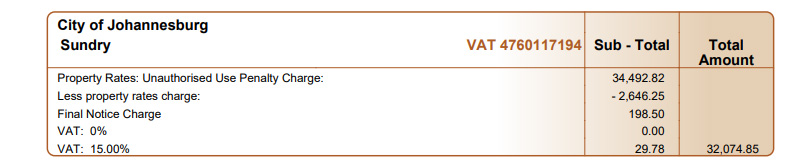
In this regard, it should be noted that historically the penalty charges were not billed under the heading of sundry in the City of Johannesburg. It was billed previously billed under the heading of property rates, where the City would bill your ordinary rates charges, then reverse them and bill you based on the penalty tariff. It is only after the Zibi judgment that the City started billing these charges under the sundry section.
ARE PENALTY CHARGES IMPOSED BY MUNICIPALITIES LAWFUL?
The authority for municipalities to levy rates and tariffs arises primarily from two statutes: the Local Government: Municipal Property Rates Act 6 of 2004 (“the Rates Act”) and the Local Government: Municipal Systems Act 32 of 2000 (“the Systems Act”). The Rates Act outlines how properties are valued and categorised, and it prescribes the processes for adopting rate policies. The Systems Act provides for the establishment of tariffs for services rendered by the municipality.
However, these statutes do not give municipalities unfettered discretion to impose penalties. Charges that are punitive in nature (that is, fines or sanctions for unlawful conduct) must be authorised by legislation or relevant by-laws. In the absence of such authorisation, or if imposed without following the correct procedures, the penalties may be invalid and open to legal challenge.
As such, we now need to assess in terms of what empowering provisions the City could possibly charge the penalty rates charges set out as the unauthorised use tariff. The starting point would be the Rates Act and the Systems Act. Without going into too much of the boring and legalistic details, suffice it to say, that neither of these Acts give a municipality the express or even implied or tacit authority to impose a penalty tariff.
The fact that the Systems Act does not give this authority was confirmed in Radius Projects (Pty) Ltd v City of Tshwane Metropolitan and Another2. In this case the City of Tshwane demanded an amount for commencing building activities without prior approval. The court held that the municipality lacked legal authority to impose the charge. The court highlighted that legislation, such as the National Building Regulations and Building Standards Act (“the Building Act”), the Local Government Ordinance, and the Systems Act, clearly state that fines can only be imposed after conviction of an offence through a judicial process in an open court. The Building Act, for example, allows for a fine for unauthorised building, but a conviction in a court is stated to be a pre-requisite for the imposition of such a fine. The municipality attempted to justify the charge under Section 75A of the Systems Act, which permits levying fees, charges, or tariffs for municipal functions or services. However, the court found that this section does not authorise the imposition of punitive fines or penalty charges for legal transgressions. By attempting to impose a fine under Section 75A, which goes beyond the specific penal provisions and requirements of the Building Act, the municipality acted ultra vires (beyond its legal power), rendering the charge null and void.
Further to the above, there is also caselaw that confirms that a municipality cannot create provisions in its laws or policies that are not authorised by the empowering provisions. In Govan Mbeki Local Municipality v Glencore Operations South Africa (Pty) Ltd and Others; Emalahleni Local Municipality v Glencore Operations South Africa (Pty) Ltd and Others3 the municipalities in question attempted to enforce property transfer embargoes, if a property owner (or a developer or previous property owner) had done something on their land, like built an extension or changed how the land was used, without getting the proper planning or building approvals first. The municipalities, Govan Mbeki and Emalahleni, had passed by-laws stating that you could not sell or transfer your property until the property owner had all town planning certificates (to the satisfaction of the municipalities in question) and approved building plans in accordance with what was actually built on the property.
The Constitutional Court’s majority decision was to declare the entire sections of these by-laws (Section 76 of the Govan Mbeki By-Law and Section 86 of the Emalahleni By-Law) that contained these requirements to be unlawful and invalid. This was because the municipalities did not have the legal power or authority to create such embargoes that stopped property transfers. The Court viewed regulating property transfers as a job for the national government, not local municipalities.
In the above case, the Constitutional Court examined all of the empowering provisions, including the Constitution itself, to ascertain whether or not the municipalities in question had the power to create the transfer embargoes in their by-laws and/or policies. Again, without going into the detail, the court did find that while the municipalities had the power to create by-laws, they could only do so within the realm of the laws that empowered them to do so and to go above those powers was ultra vires. This means that the highest court in the land has confirmed that a municipality cannot create laws in their by-laws or policies that go above and beyond their authority.
SPLUMA
The next piece of legislation to look into is the Spatial Planning and Land Use Management Act 16 of 2013 (“SPLUMA”). This Act regulates town planning on a municipal level and gives a municipality the authority to create by-laws to regulate same and also Town Planning Schemes or Land Use Schemes. These essentially regulate what, how and where building and land use can take place within a municipality, what applications need to be made to obtain the necessary authorisations and what processes need to be attended to in order to do so.
The City of Johannesburg Metropolitan Municipality created the Municipal Planning By-law in or about 2016, which has recently been updated in 2024. This by-law mirrors exactly what SPLUMA says in respect of transgressions in respect of any of the provisions of the by-law. In a nutshell it sets out that the City may advise you in writing of any transgressions, advising you of your transgression and the time frame it is providing you within which to correct such transgressions. Should you then not correct such transgressions, the City would be entitled to either attend to the correction of the transgressions on your behalf (and hold you liable for any expenses incurred as a result), or it can prosecute you for same and a judge or a magistrate can then find you guilty of an offence and imprison and/or fine you. There is no empowerment in SPLUMA for a municipality to create punitive tariffs or penalty charges (rates or otherwise) for non-compliance with SPLUMA or town planning bylaws or policies.
The City also created a consolidated Land Use Scheme in 2018, which gives various details with regard to how properties are to be developed and/or amended. The Land Use Scheme mirrors the abovementioned By-Law and refers to same with regard to any contraventions that occur. As such, again, the law only provides for fines or penalty charges where the City or state has prosecuted you and a court has found you guilty and imposed a fine and/or imprisonment.
SO THEN HOW SHOULD PENALTY CHARGES IMPOSED BY COJ BE DEALT WITH, IN THEORY?
As such, from the legislation that regulates development or alterations to buildings and uses of properties, it is clear that any transgressions therewith, will lead to the City either “fixing” those transgressions for you at your cost, or to your prosecution. If you are then found guilty of an offence, you will be imprisoned and/or fined by a court (not by the municipality).
PENALTY CHARGES IMPOSED BY COJ IN PRACTICE
In a case that was recently before the South Gauteng High Court, a fine imposed by Joburg Water, in contravention to what the by-laws said the City could do in the case of purported non-compliance with the Water By-Laws, it was held that the City could not in fact impose a fine without having followed the due process as set out in the By-Laws.
In Waterfall Country Estate (Pty) Ltd and Others v City of Johannesburg and Others4 the core issue before the court was the legal empowerment of a designated officer of the City to issue a fine to a consumer for purported non-compliance with the By-Laws. The respondents (the City of Johannesburg and Johannesburg Water) explicitly relied only on Section 111 of the Water Services Bylaws to justify the charges, accepting that the amounts in question were indeed penalties. The High Court found the penalties to be unlawfully issued, as neither the City of Johannesburg nor Johannesburg Water could identify any provision within the Bylaws, or any other legal power, that specifically authorised the designated officer to create and impose these particular penalties.
Section 111 itself does not create penalties; rather, it only authorises the imposition of penalties that are created elsewhere in the Bylaws. The respondents failed to point to any such underlying power. The only authority to issue such a penalty, was under section, which set out that a person contravening any of the sections of the By-Law, had to be prosecuted and found guilty of an offence. This process had not been followed in this matter.
As such, the Water By-Laws contained similar provisions to the Municipal Planning By-Law and the fines imposed by the City, without following the process set out in those By-Laws, was found to be unlawful.
CONCLUSION
Penalty tariffs imposed by municipalities for unauthorised land use may appear to be a quick and effective enforcement tool to municipalities, but they must be grounded in lawful authority and implemented in accordance with proper procedures. Several South African courts have cautioned against the use of administrative penalties that bypass judicial processes or exceed the scope of legislative mandates.
On the strength of the above case law the authors opine that the City’s unauthorised use rates tariff as imposed by the City through the functioning of the Rates Policy, are also unlawful. However, it is not only the implementation of the unauthorised use tariff that is unlawful, but also the very existence of the penalty tariff in the first place. That being said, it is of course for a court to decide and not for the writers hereof, but in our informed opinion, this is the case.
For property owners, this means that any penalty reflected on a municipal account should be scrutinised closely. If a charge is not properly explained, is not authorised by a by-law or policy (or you think that even if it is authorised by same, that it could be unlawful), or appears to be punitive in nature, legal advice should be sought to assess its lawfulness. Conversely, municipalities must ensure that their enforcement mechanisms comply with the Constitution, national legislation, and their own enabling statutes. A failure to do so exposes them to legal challenges and undermines public confidence in the legitimacy of their governance.
1City of Johannesburg Metropolitan Municipality v Zibi and Another 2021 (6) SA 100 (SCA).
2Radius Projects (Pty) Ltd v City of Tshwane Metropolitan and Another (7813/07) [2007] ZAGPHC 127 (28 June 2007).
3Govan Mbeki Local Municipality v Glencore Operations South Africa (Pty) Ltd and Others; Emalahleni Local Municipality v Glencore Operations South Africa (Pty) Ltd and Others 2025 (2) SA 238 (CC) (19 November 2024).
4Waterfall Country Estate (Pty) Ltd and Others v City of Johannesburg and Others (2023/8060881) [2025] ZAGPJHC 437 (9 May 2025).

PARTNER

PARTNER

ASSOCIATE

CANDIDATE ATTORNEY